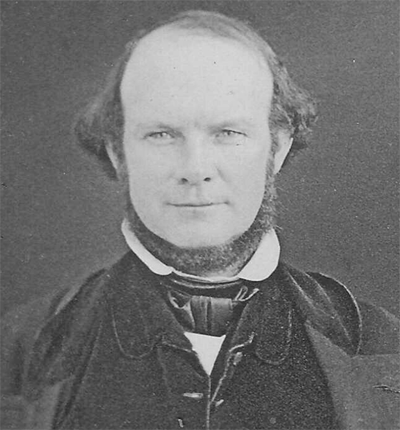
Henry Lindsay Brown was born on December 2, 1814, as the third child and third son to Henry Brown, one of Dayton's early merchants and settlers, and Catherine "Kitty" Patterson Brown, daughter of Colonel Robert Patterson, a famous Revolutionary War soldier and Native-American fighter, who settled in Dayton in 1804. Henry L. was born and raised in the original 1808 brick home that his father built on Main Street.
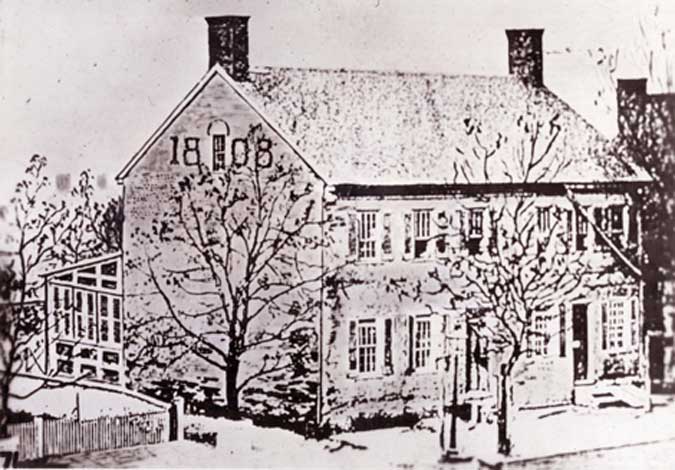
Henry L. likely worked and played with his siblings in the "in-lot" on the south side of the brick house where their father kept livestock, an outhouse, a well, and a kitchen garden.
LINK TO ENDNOTE: What are "in-lots" and "out-lots?"
Because his mother, Kitty, valued education, Henry L. likely attended the Dayton Academy for his primary education. There, he would have learned reading, writing, and arithmetic.
LINK TO ENDNOTE: What was the Dayton Academy?"
Dayton did not organize a high school until 1850. Instead, Henry L. went to boarding school at Paddy's Run, near Hamilton, Ohio, for his secondary education. He lived with the Reverend Thomas and his family. Rev. Thomas taught the boys advanced classes and Mrs. Thomas taught the girls sewing and other house-making skills. No further information about Henry L.'s education is available.
LINK TO ENDNOTE: What was Paddy's Run?"
Early in his career, Henry L. was involved with various educational enterprises. In 1833, he was a founder of the Mechanics Institute in Dayton and served as its secretary. The Mechanic's Institute was dedicated to "moral, literary, and scientific improvement" (pp. 253, Edgar, 1896). The institute had a library and reading rooms.
LINK TO ENDNOTE: What prompted the formation of the Mechanics Institute?
Henry L. also served on the Dayton Board of Education from 1850 through 1873. In 1850, he proposed establishing a high school. From 1850 until 1857, high-school classes were taught at the Dayton Academy until Central High School was dedicated in 1857.
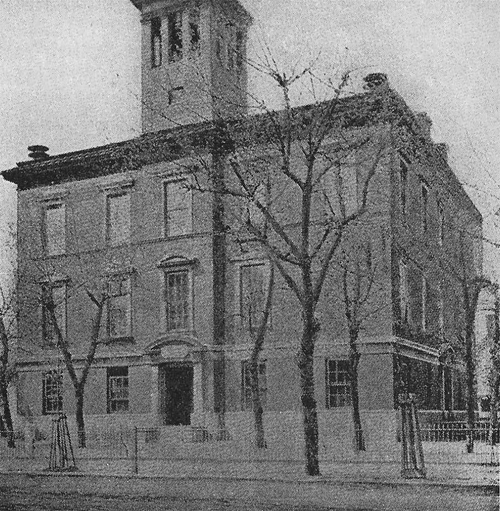
On February 7, 1837, Henry L. married Sarah Belle "Blossom" Browning of Indianapolis. In 1851, Henry L. and Sarah built a brick home on Ludlow Street behind Henry L.'s parents' home. Henry L. and Sarah would have nine children, eight lived to adulthood.
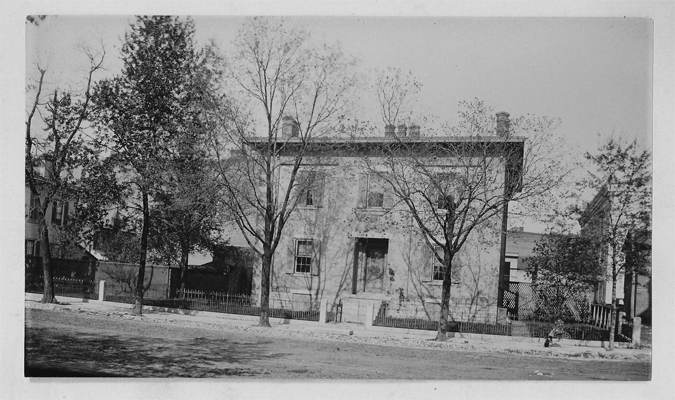
LINK TO ENDNOTE: Who were Henry L. and Sarah Brown's children?
LINK TO ENDNOTE: Read about Henry L. and Sarah Brown's children's marriages!
Later Career
After Sarah died on November 25, 1858, Henry L. began a new career in cast-iron manufacturing.
By early 1859, Henry L. and his younger, half-brother, Andrew "Barr" Irwin, took ownership of an iron foundry. It was located at the south end of Ludlow Street where it terminated at the Miami Canal. The foundry produced cast-iron stoves and other hardware. Many of its products, such as cast-iron fences and gates, are still in use in the Dayton area, as well as kettles, skillets, and "frog" doorstops
The half-brothers initially sold their iron products from a stand at the corner of East First and Mill Streets (now Patterson Boulevard). Later, they opened the Brown & Irwin Stove and Hollow-Ware Store at 89 Main Street in downtown Dayton.
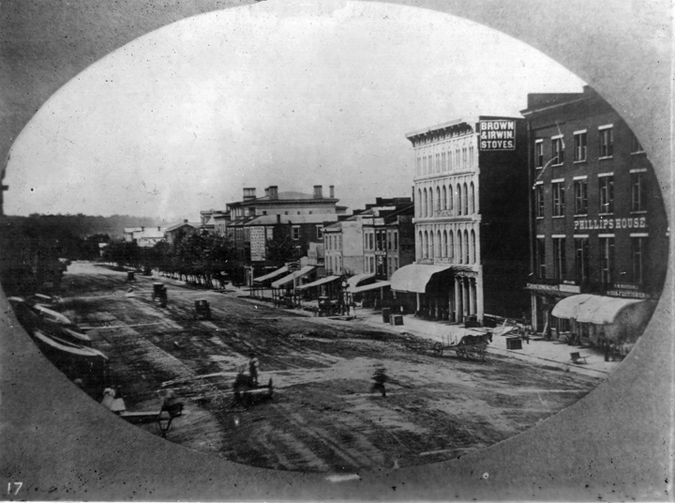
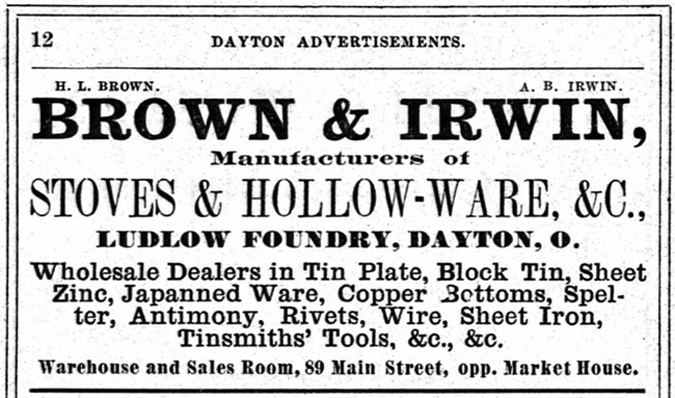
The Brown & Irwin Stove and Hollow-Ware Store remained in business for nearly 20 years.
Later Life
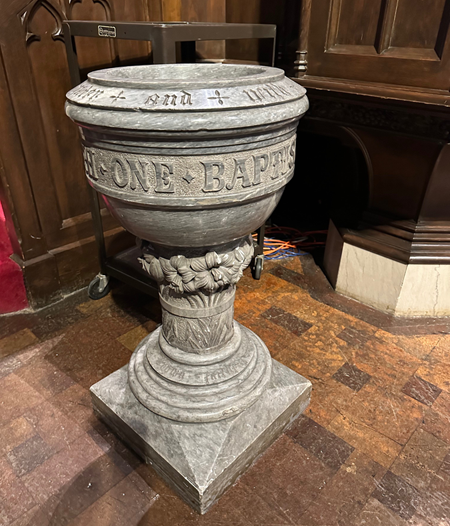
After Barr moved to Kentucky in 1877, Henry L. closed the iron foundry and store. He focused his attention on serving as a deacon in the First Presbyterian Church (now Westminster Presbyterian Church) and as its Sunday-school superintendent. In 1876, Henry L. donated a carved, marble baptismal font to the church that is still used today.
Woodland Cemetery was founded in 1841, farther outside Dayton, after plans for a railroad line threatened to cut through the commonly used old Fifth Street Cemetery. Henry L. and other prominent Dayton families were among the first plot certificate-holders.
Kitty, Henry L.'s mother, wanted to be buried with her first husband (Henry Brown), but also close to her Patterson parents. The Browns and Pattersons purchased a knoll high on a hill overlooking the Miami River Valley.
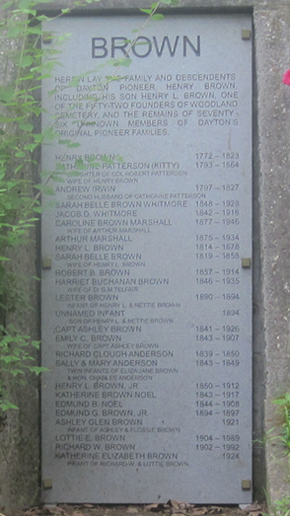
Henry L. built an in-ground vault for the Brown family. Inside are iron boxes made in his iron foundry containing the remains of 76 unclaimed and undocumented people that he had once known; they were previously buried in the Fifth Street Cemetery. Many Brown family members are also buried in the vault.
Death
On November 25, 1878, Henry L. Brown died twenty years after Sarah. Both are buried within the Brown vault, along with his parents.
ENDNOTE - What are "in-lots" and "out-lots?"
In early settlements, where Native Americans posed danger, most settlers had "in-lots" within the town limits. These were typically adjacent to settlers' homes where they could keep a horse for transportation, a cow for milk, a few chickens for meat and eggs, and a few pigs for meat. The in-lots were usually no more than 1/4 acre and not intended for regular farming.
The in-lot might have a small barn and chicken coop, and a kitchen/medicinal garden. It would also contain a well for water and the family outhouse. Because the in-lots were small and held animals, it often resulted in unpleasant smells, disease, and sanitation issues. However, they offered protection for precious food sources.
These settlers typically had “out-lots” for growing crops outside of the town limits. Most of the work of growing crops was done during the daylight hours when threats from Native Americans could be seen.
Out-lots also gave settlers a measure of self-sufficiency. They could grow crops for their own use and often transport surplus harvests to markets such as Cincinnati or farther south to New Orleans, where the sales provided additional income.
ENDNOTE - What was the Dayton Academy?
As no state-wide program for education existed in Ohio before 1825, the citizens of Dayton contributed to a public fund to build a school on land that Daniel Cooper, one of Dayton's founders, donated. The original academy was built between 1808 and 1810 on the west side of St. Clair Street between Second and Third Streets (now the site of the St. Clair Lofts). The first teacher, William M. Smith, began classes in his house in 1808. Originally, admission was restricted to male students from families who paid tuition.
With Ohio initiating a tax-funded public school system in 1825, girls were admitted to school by 1840 and no tuition was charged. This meant that all students, regardless of their parent's income, could attend school.
ENDNOTE - What was Paddy's Run?
Paddy's Run (called Shandon today) was a settlement of Welsh immigrants established in 1801 in Butler County, southeast of Dayton, Ohio. It was the first Welsh settlement in Ohio. Its most notable feature was its focus on education.
By 1803, a Congregational Church had been established, followed soon after by a primary school and library. Although informal classes were held earlier, the first school building was constructed in 1810. The primary school taught boys and girls reading, writing, arithmetic, and religion. Although boys and girls were expected to follow different life paths, the Congregational Church emphasized literacy, religion, and arithmetic for both sexes.
The Rev. Thomas Thomas founded a high school at Paddy's Run in 1821. Rev. Thomas taught advanced classes, such as Greek and Latin, for boys while his wife taught classes in sewing and household arts to girls.
A state-chartered public school was built at Paddy's Run in 1826 under the new Ohio state education law. At that time, Rev. Thomas was assigned a new ministry and left Paddy's Run in 1827.
ENDNOTE - What prompted the formation of the Mechanics Institute?
After winning the War of 1812 and with the removal of most Native Americans tribes from Ohio in the 1830s, the residents of Dayton and surrounding areas felt safe enough to focus on other aspects of their lives. One of these was establishing educational organizations.
The founding of the Mechanic's Institute was only one of several educational institutions organized in the post-settlement phase. Others included the Dayton Lyceum (1832), Adelphic Society of the Dayton Academy (1837), and Cooper Female Seminary (1844). The Public-School Library was founded in 1855 and is the ancestor of today's Dayton Metro Library.
ENDNOTE - Who were Henry L. and Sarah Brown's children?
Henry L. and Sarah Brown had nine children, eight living to adulthood. They were:
ENDNOTE - Read about the marriages of Henry L. and Sarah Brown's children!
Marriages of Henry L. and Sarah Brown's children:
Brown, H. L., & Irwin, A. B. (1859, April 5). Dealers in Juniatta Iron Nails [Advertisement]. Dayton Daily Empire, 4, newspapers.com
Conover, C. R. (1902). Concerning the Forefathers: Being a Memoir, with Personal Narrative and Letters of Two Pioneers, Col Robert Patterson and Col John Johnston. New York: Winthrop Press.
Conover, C. R. (Ed). (1914). A Memoir: With Letters, of Mrs. Horatio G. Phillips, "Kitty" Patterson, A Pioneer Woman. Dayton, OH: N.C.R. Co.
Conover, C. R. (1917). The Story of Dayton. Dayton, OH: The Greater Dayton Association/The Otterbein Press.
Drury, A. W. (1909). History of the City of Dayton and Montgomery County, Ohio, Vol. I. Chicago: S. J. Clarke.
Edgar, J. F. (1896/2008). Pioneer Life in Dayton [Ohio] & Vicinity, 1796-1840. Westminster, MD: Heritage Books.
Knepper, G. W. (1989). Ohio and its People. Kent, OH: The Kent State University Press.
Williams' Dayton Directory, City Guide, and Business Mirror. (1860). Dayton, OH: James Rickey.