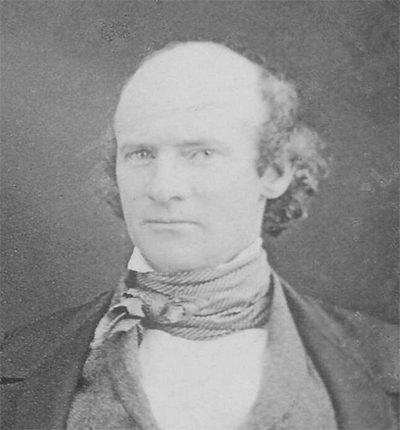
Robert Patterson Brown was born on December 6, 1811, as the first child and son to Henry Brown, one of Dayton's first merchants and settlers, and Catherine "Kitty" Patterson Brown, daughter of Colonel Robert Patterson, a famous Revolutionary War soldier and Native-American fighter, who settled in Dayton in 1804. Robert P. Brown was born and raised in the original 1808 brick home that his father built on Main Street.
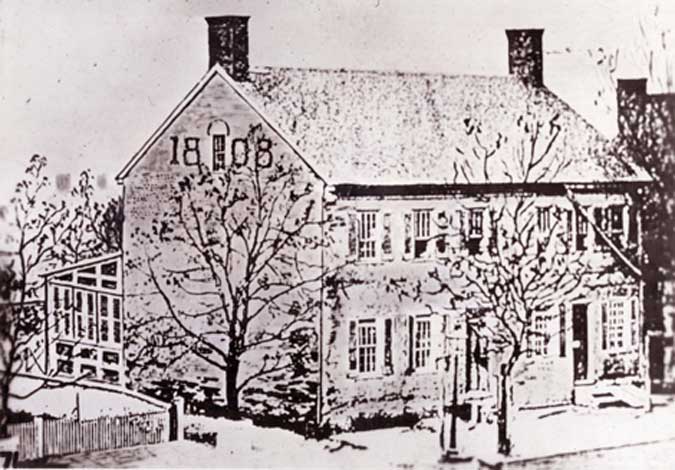
Robert P. likely worked and played in the "in-lot" on the south side of the brick house where his father kept livestock, an outhouse, a well, and a kitchen garden.
LINK TO ENDNOTE: What are "in-lots" and "out-lots?"
Because his mother, Kitty, valued education, Robert P. likely attended the Dayton Academy for his primary education. There, he would have learned reading, writing, and arithmetic.
LINK TO ENDNOTE: What was the Dayton Academy?"
Information about Robert P.'s secondary education remains unknown, as Dayton did not establish a high school until 1850. In a secondary education program, Robert P. would have studied English, modern and ancient languages, natural sciences, geography, mathematics, and moral philosophy. He likely received some secondary education.
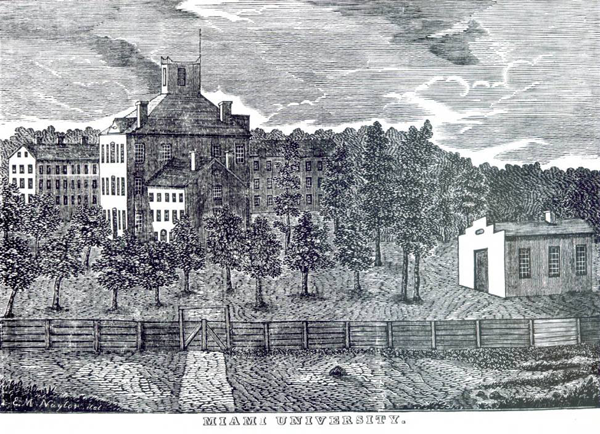
Robert P. graduated from nearby Miami University in Oxford, Ohio, in 1830 with a general liberal arts degree. He later served there as an assistant professor of Latin and Greek, working alongside the prominent educator Reverend William H. McGuffey.
LINK TO ENDNOTE: Who Was William H. McGuffey?"
From 1833 to 1834, Robert P. studied law at Transylvania University in Lexington, Kentucky, where he earned an LL.B. degree. His grandfather, Col. Robert Patterson, the founder of Lexington, was also one of the university's founders.

Robert P. returned to Dayton in 1835 as an attorney. He established a law office on West Third Street (where the Dayton Arcade's north entrance now stands). His office was directly across from the old brick courthouse, built in 1805.

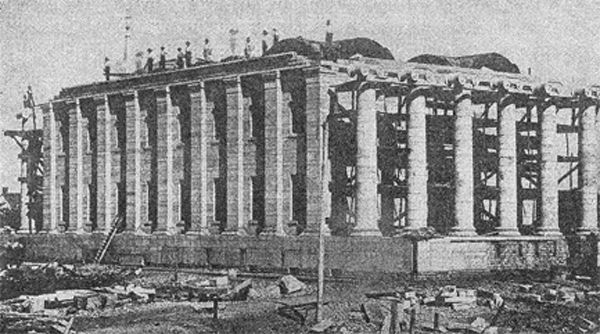
Robert P. became an Associate Judge of the Court of Common Pleas for Montgomery County in 1845. In 1848, he served as the Justice of the Peace in Dayton. When a new courthouse was completed in 1850, Robert P. helped to dedicate it.
Robert P. married Sarah Ann Galloway of Xenia, Ohio, on October 31, 1837. Sarah was the granddaughter of James Galloway, Sr., a Revolutionary War soldier and settler from Kentucky. The Galloways were friends of the Pattersons and moved to Greene County, Ohio, in 1798.
Robert P. and Sarah had six children, but only three lived to adulthood. Robert P.'s younger sister, Eliza, and her husband, Charles, would follow the same pattern in losing half of their children at an early age.
LINK TO ENDNOTE: Who were Robert P. and Sarah Brown's children?
LINK TO ENDNOTE: Why did half of Robert P. and Sarah Brown's children die so young?
When Robert P.'s grandfather, Col. Robert Patterson, died in 1827, he inherited 100 acres of land. The land was located on the Cincinnati Turnpike along the west bank of the Great Miami River. There, Robert P. built a large brick home for his family in the popular Italianate style.
LINK TO ENDNOTE: Read about the marriages of Robert P. and Sarah Brown's children!
Later Life
By 1871, Robert P. was no longer listed as a judge or attorney in William's Directory for Dayton, suggesting that he had likely retired from practice.
Death
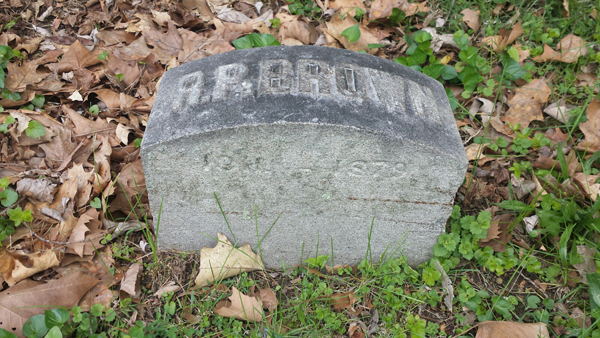
While visiting his daughter, Mary F. Brown Campbell, in Kansas City, Missouri, Robert P. became ill. Robert P. Brown died on May 4, 1879, and his remains were returned to Dayton for interment in Woodland Cemetery.
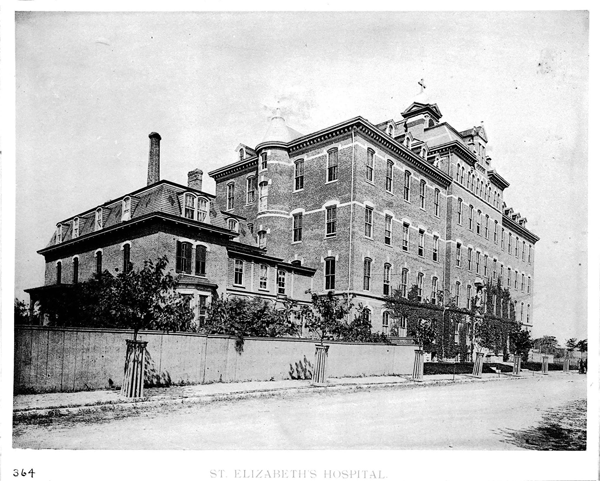
After Robert P.'s death, his home and land were sold to the Franciscan Sisters of the Poor in 1881. Using the house as their convent, the sisters would build St. Elizabeth Hospital.
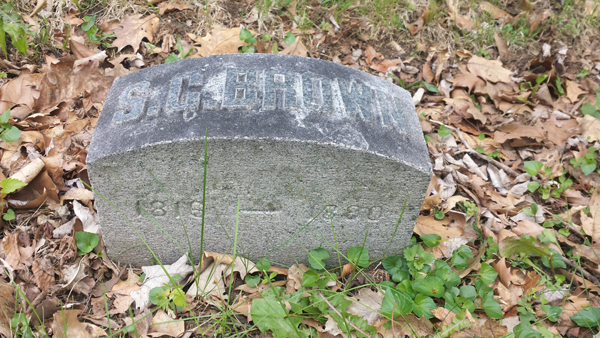
Robert P.'s wife, Sarah, died on February 5, 1890; she is buried next to him in Woodland Cemetery, Dayton. They are buried near the Brown family vault.
ENDNOTE - What are "in-lots" and "out-lots?"
In early settlements, where Native Americans posed danger, most settlers had "in-lots" within the town limits. These were typically adjacent to settlers' homes where they could keep a horse for transportation, a cow for milk, a few chickens for meat and eggs, and a few pigs for meat. The in-lots were usually no more than 1/4 acre and not intended for regular farming.
The in-lot might have a small barn and chicken coop, and a kitchen/medicinal garden. It would also contain a well for water and the family outhouse. Because the in-lots were small and held animals, it often resulted in unpleasant smells, disease, and sanitation issues. However, they offered protection for precious food sources.
These settlers typically had “out-lots” for growing crops outside of the town limits. Most of the work of growing crops was done during the daylight hours when threats from Native Americans could be seen.
Out-lots also gave settlers a measure of self-sufficiency. They could grow crops for their own use and often transport surplus harvests to markets such as Cincinnati or farther south to New Orleans, where the sales provided additional income.
ENDNOTE - What was the Dayton Academy?
As no state-wide program for education existed in Ohio before 1825, the citizens of Dayton contributed to a public fund to build a school on land that Daniel Cooper, one of Dayton's founders, donated. The original academy was built between 1808 and 1810 on the west side of St. Clair Street between Second and Third Streets (now the site of the St. Clair Lofts). The first teacher, William M. Smith, began classes in his house in 1808. Originally, admission was restricted to male students from families who paid tuition.
With Ohio initiating a tax-funded public school system in 1825, girls were admitted to school by 1840 and no tuition was charged. This meant that all students, regardless of their parent's income, could attend school.
ENDNOTE - Who was William H. McGuffey?
William Holmes McGuffey, the son of Scottish immigrants, was born on September 23, 1800, near Claysville, Pennsylvania. His family moved to the western frontier in Tuscarawas County, Ohio, in 1802. There, he studied in country schools, eventually attending Greersburg Academy in Darlington, Pennsylvania.
When he was 14 years old, William became a roving teacher who taught in one-room classrooms throughout the frontier in Ohio, Kentucky, and western Pennsylvania. While teaching, he took classes at Washington College in Pennsylvania, graduating in 1826. He then became an instructor there.
However, William soon left for Miami University in Oxford, Ohio, to become a professor of ancient languages. He was ordained a Presbyterian minister in 1829. In 1832, William was appointed as the chair of moral philosophy at Miami.
A Cincinnati publisher, Truman and Smith, hired William to write a series of graded books for elementary-school children. William wrote the first four and his brother, Alexander, wrote the fifth and sixth books. These became the McGuffey Readers series, one of the most significant developments in the standardization of teaching in the United States.
Beginning in 1836, William took positions as president with Cincinnati College, Ohio University, and finally, the Woodward Free Grammar School in Cincinnati, one of the country's earliest public schools.
From 1845 till his death on May 4, 1873, William was the chair of moral philosophy and political economy at the University of Virginia in Charlottesville, Virginia.
ENDNOTE - Who were Robert P. and Sarah Brown's children?
Robert P. and Sarah Brown had six children, only three lived to adulthood. They were:
ENDNOTE - Early death of half of Robert P. & Sarah Brown's Children
The exact cause of death for Robert P. and Sarah Brown's children cannot be stated with any certainty. And Ohio did not require death certificates until January 1866. However, Greene County, Ohio, adjacent to Montgomery County, kept excellent records on infant mortality in the early 19th century. Looking at its records is helpful. They show that infant mortality was exceptionally high, with up to 30% of children dying before their first birthday and over 40% not surviving past age five. The common causes included diarrhea, dysentery, prematurity, and infections, often driven by poor sanitation. (https://www.greenecountyohio.gov/Blog.aspx?IID=180)
An earlier endnote referred to the use of in-lots adjacent to city homes where livestock (chickens, pigs, a cow, and a horse) would be kept handy. These animals typically shared a small amount of space with the family outhouse and well. The possibility of contamination was high.
However, Robert P. and Sarah inherited a large property (100 acres) on which they built their home. With such a vast expanse of land, it was unlikely that they maintained a small area for their farm animals close to the family outhouse and well. Still, modern germ theory was not developed before 1860. Therefore, inadequate sanitation may have contributed to the high incidence of childhood mortality in Robert P. and Sarah's family.
ENDNOTE - Read about the marriages of Robert P. and Sarah Brown's children!
Marriages of Robert P. and Sarah Brown's children:
Conover, C. R. (1902). Concerning the Forefathers: Being a Memoir, with Personal Narrative and Letters of Two Pioneers, Col Robert Patterson and Col John Johnston. New York: Winthrop Press.
Conover, C. R. (Ed). (1914). A Memoir: With Letters, of Mrs. Horatio G. Phillips, "Kitty" Patterson, A Pioneer Woman. Dayton, OH: N.C.R. Co.
Conover, C. R. (1917). The Story of Dayton. Dayton, OH: The Greater Dayton Association/The Otterbein Press.
Dalton, M. (2018, September 21). Diseases and Child Mortality in Early America. Greene County Archives. https://www.greenecountyohio.gov/Blog.aspx?IID=180
Drury, A. W. (1909). History of the City of Dayton and Montgomery County, Ohio, Vol. I. Chicago: S. J. Clarke.
Edgar, J. F. (1896/2008). Pioneer Life in Dayton [Ohio] & Vicinity, 1796-1840. Westminster, MD: Heritage Books.
Knepper, G. W. (1989). Ohio and its People. Kent, OH: The Kent State University Press.
Williams' Dayton Directory, City Guide, and Business Mirror, Vol. 8. (1870-71). Cincinnati, OH: Williams & Co.